
From EncyclopAtys
“
- Many homins ask themselves questions about the masks that the Zoraïs wear. After a long research, a Zoraï has accepted to lift a curtain on this so sensitive subject.
Reporter: Good morning to you, thank you for accepting to answer our questions. Could you please introduce yourself?
Cioi Ba-Nung: My name is Cioi Ba-Nung, Ma-Duk follower and tattooist for homins in Zora.
Reporter: All the homins wonder about the passion of Zoraïs for masks, tattoos and hairstyles. Can you give us some explanation for this keen interest in adornments?Cioi Ba-Nung: Let’s begin at the beginning. First of all, the masks are the only things to be really sacred in the eyes of our people. Tattoos and hairstyles carry out cosmetic functions, shared by all the homin peoples.
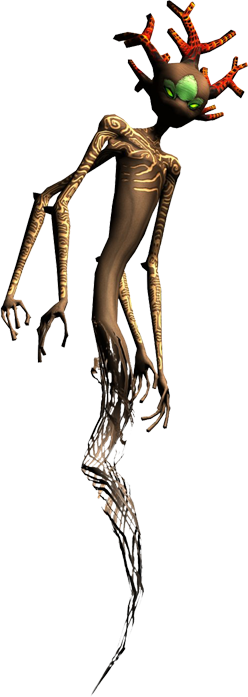
Reporter: Our subject is becoming clearer, thank you for this remark. What is sacred about these masks then?Cioi Ba-Nung: Our masks are the living sign of the alliance forged between our people and Ma-Duk. They are also the link that ties us to him and make each Zoraï one of its relatives. That is why we call our masks, the kinship masks.
Reporter: And do you know who forged this alliance?Cioi Ba-Nung: All the Zoraï children know that! This alliance was forged by the great and wise Cho. He was the first Zoraï to wear a mask and from then on, tradition has handed down the wearing of the mask, and that since 2201. This alliance follows the encounter between the Kamis and Cho.
Reporter: Well, why choose a mask as the tangible sign of your alliance with Ma-Duk?Cioi Ba-Nung: The Kamis refuse duplicity and lies; the homin face is not the window of the soul but a deceptive façade. For the initiated, kinship masks are the true windows of the soul, no lie, no dupery is then possible.
Reporter: You mean the mask you wear represents your… soul?Cioi Ba-Nung: As a matter of fact yes! I understand your astonishment. How can a soul be read on a mask? Do you think our kinship masks are only masks?
Reporter: Hum… After what you’ve just said, certainly not… By the way, where do your masks come from?Cioi Ba-Nung: Our masks are given to us by the Kamis at the end of the adoption ceremony. Our masks are a Kami creation and not the result of homin labour. The adoption ceremony marks the transition between childhood and adulthood for the Zoraïs.
Reporter: A ceremony…can you describe it to us?Cioi Ba-Nung: Sure. Each cycle, children old enough to take part in the ceremony are invited to Zora. This meeting is followed by a big celebration, the adoption celebration. It is a great moment of joy and communion. The celebration lasts six days and six nights during which access to the city is forbidden to strangers. At the end of the celebration, the Kamis take the children.
Reporter: You mean the Kamis take your children?Cioi Ba-Nung: Yes…Could you let me finish please?
Reporter: Hum yes, please go on.Cioi Ba-Nung: The Kamis teleport themselves with the children into the Eternal Tree. It is a wonderful place where an everlasting spring reigns, animals live in peace; I still remember the raguses that played with us. It’s a pity Atys was corrupted by the Goo and the Karavan.
Reporter: What about the children, what do they do?Cioi Ba-Nung: They take part in the adoption ritual. It is composed of four ceremonies.
The first one is collection. The Kamis ask each child to collect certain items, and then the children scour the Eternal Tree for them. When each child has filled his Hai-Phon, a bag weaved by his/her family, the second ceremony can begin.
This is the one of separation. The Kamis invite the children to make the collected items into a figure. The making up must bring the child to distinguish between truth and illusions. This ceremony is very long, every one of them taking their own path. Some achieve it in a few months, others in a few cycles.
The third ceremony is that of purification. The children meditate, focused on their making up in order to free themselves from illusions and lies. There again, this ceremony takes months, even cycles.
The last ceremony is that of adoption. The young homins then go down to the chambers of dreams, hidden deep into the roots of the Eternal Tree. They stay there for a few days, deep in a trance that enables them to initiate harmony with Ma-Duk. During this trance, the Kamis give each child their kinship mask. When the child wakes up, s/he is back in the jungle, not far from Zora and will wear his/her kinship mask forever. From now on, s/he is no longer a child but an adult.
Reporter: So many revelations! Do all the children succeed in passing the ceremony?Cioi Ba-Nung: They do. It can take years but all the Zoraï children complete these ceremonies. Some Karavan agents say that Zoraï children were eliminated by the Kamis because they refused the ritual. It is pure calumny!
Reporter: A question comes to my mind, are there Zoraïs who end up following Jena’s path?Cioi Ba-Nung: The path of each homin is known only by him/herself and Ma-Duk. Our brothers and sisters you are talking about have this passage written in their lives, in their selves. It is not a betrayal, only a necessary detour, an experience which will get them even closer to Ma-Duk and which will guide them towards Illumination.
Reporter: Your faith is admirable. I would like to come back to the masks, are they alive, as some say?Cioi Ba-Nung: Yes, they are alive and delicate, as much as the face of each homin. They are made of bone, of cartilage, of flesh and of sap. Kinship masks are obviously irremovable, who would want to mutilate oneself like that? Such an act would be suicide by the way, a Zoraï cannot survive without his/her kinship mask. Our masks are the reflection of our souls, our passions, our feelings, our fears and our hopes. They are certainly the most intimate part of our selves.
Reporter: What do the horns displayed on your masks stand for?Cioi Ba-Nung: I cannot reveal you everything, you are not initiated. Just know that these horns are there in honour of the great Kami-Ko of Equilibrium that Cho met.
Reporter: One last question, how do the Kamis make those masks and how do they fix them on your faces?Cioi Ba-Nung: I cannot reveal this piece of information to you either, but your curiosity is a gift from Ma-Duk. I invite you to follow the Kamis’ teachings; you will find the answer to this question and to many more. May Ma-Duk give you the serenity of the sage.
interview with Cioi Ba-Nung, a Tattooist for Homins.

The Chronicles of Atys
|
|---|
| History • Chronicles Overview |
Before the Great Swarming
|
|---|
| Fire of Coriolis
The Fever of Discovery • The Siege of Karavia • The Company of Loria • The Youth of Loria • The Assassination of Loria • The Liberation of the Trykers |
Chronicles of the Great Swarming - From 2481 to 2484 (JY)
|
|---|
| Massacre and flight
A Kitin Story • Monsoon Sunset • My Karavan Guardian • The Kitin Song The return of Hope |
Chronicles of the New Beginning - From 2484 to 2525 (JY)
|
|---|
| Chronicles of Aeden Aqueous
The Secrets of Tryker engineering • A Flyner Escape • The Story of a Young Corsair Chronicles of the Verdant Heights A Little Lore at Bedtime • Ciochini learns of His Heritage • Chrysalis • Screaming Shadows Chronicles of the Witherings Tears of Serenity • The Crying Mektoub • The Stance of Daïsha • Mabreka |